
PNG Officials Complete Specialized Training on Digital Trade Negotiation Tools (TINA and Legal TINA)
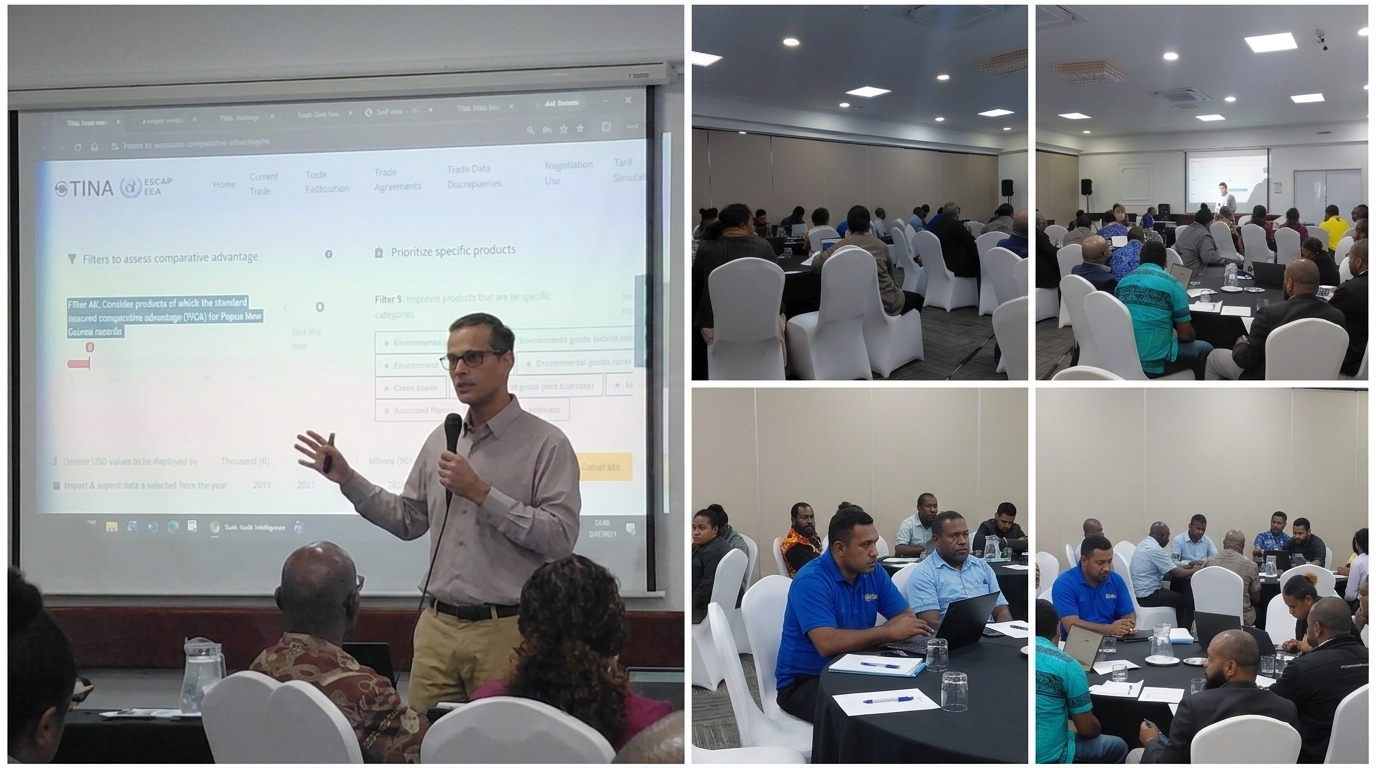
Papua New Guinea trade officials have successfully completed a two-day specialized training workshop on the Trade Intelligence and Negotiations Advisor (TINA) and Legal TINA. Co-organized by the National Trade Office (NTO) of the Ministry of International Trade & Investment and the United Nations Economic and Social Commission for Asia and the Pacific (ESCAP), the workshop was held at the Crown Hotel in Port Moresby from 17 to 18 November 2026.
Empowering Trade Policymakers and Negotiators
Developed by ESCAP, TINA (https://tina.trade) and Legal TINA (tina.trade) are state-of-the-art online tools designed to help trade policymakers, researchers, and consultants prepare for trade negotiations and assess policy impacts.
By automating complex data management and analytical tasks that are otherwise time-consuming to perform manually, these platforms enable economies with limited resources to achieve the same level of analytical preparation as larger economies.
- TINA allows officials to simulate the effects of tariff changes and trade policy scenarios, utilizing data on tariffs, non-tariff measures (NTMs), trade agreements, and bilateral trade flows to identify priority products and negotiating opportunities.
- Legal TINA serves as an extension that helps negotiators explore legal frameworks, formulate trade agreement provisions based on national priorities, and search and compare texts across existing trade agreements.
Workshop Highlights
The workshop opened with remarks from Mr. Richard Yakam, Chief Trade Officer (NTO) and Chief Trade Negotiator for the PNG-UAE Comprehensive Economic Partnership Agreement (CEPA) at the Ministry of International Trade & Investment, alongside Dr. Alexey Kravchenko (Economic Affairs Officer, TPFS).
Over the two days, technical sessions were led by ESCAP experts Dr. Alexey Kravchenko (Economic Affairs Officer, TPFS). Participants engaged in theoretical lessons and practical exercises covering six core areas:
- Trade Data & Tariffs: Understanding trade data classification, types of tariffs, and scheduling approaches.
- Negotiation Strategy: Generating offensive and defensive trade interests.
- Economic Modelling: Conducting Partial Equilibrium (PE) modelling in TINA.
- Social & Economic Impact: Using Input/Output modelling to assess gender and sector-disaggregated labour impacts of trade policies.
- Trade Facilitation: Estimating the economic impacts of trade facilitation measures.
- Legal Analysis: Navigating, comparing, and understanding trade agreement texts using Legal TINA.
Way Forward
The training concluded with a closing session led by Mrs. Bridgette Kamish (Director – Trade Policy Coordination & Facilitation of NTO), and Dr. Alexey Kravchenko, outlining the way forward for integrating these digital tools into Papua New Guinea’s ongoing and future trade negotiations.
